Walter Calvo
What Are You Choosing When You Choose to Examine Your Life?
The cost is real. So is the reason people pay it.
Camino Institute™ - A Transformation Practice
Last week ended at a ceiling. She had done everything the field recommends, the reading and the certificates and the honest reckoning, and the old self reasserted itself anyway. Coaching had taken her as far as coaching goes. What came next was not another strategy.
I want to be precise about what came next, because the word “examination” makes it sound gentle, and it is not.
To examine your identity is to hold open the possibility that the self you have been identifying as is not entirely yours. Not broken. Not false. It was “just there,” built from your family’s idea of a worthwhile life, your field’s idea of a good professional, and a younger you who needed to be a certain way to stay safe. To examine it is to ask whether you would choose it again, knowing you might find that you would not.
This is a significant question, larger than anything you would find in a strategy or a book. For a while you hold loosely to what you once held as fact. The ground you stood on feels unsteady beneath your feet, and nothing has yet arrived to hang a decision on. People call that interval vertigo. They are right.
I watched this professional go through it. She had spent her career being the steady one. The person others brought their problems to, the one who held things together, until she stopped doing it and started being it. That was awareness, and the first thing to go was not a belief. It was a reflex.
She caught herself in a meeting assuming her competent, calm role as usual, and this time she saw it from outside her body, like a scene in a movie. It did not feel like insight. It felt more like the floor was tilting.
Then came three weeks of not knowing who she was when she was not carrying everyone else’s responsibilities. She described this as the worst weeks she could remember and the first honest ones.
She had no new self ready to step into. She only had the old one, a thing she could not stop seeing now. It had been costing her for years. She had just never thought to look at the bill.
So why would anyone at the ceiling pay that?
Because the alternative is not free either. This is the part the cost obscures because you are already paying. The accepted self runs in the background of every room, reading how you are received, bracing for the remark that will land wrong, and holding a shape that was never quite yours. It is the most expensive thing a person can do, and most never see the bill, because that is how it has always been done. She was not choosing between a settled life and a costly examination. She was choosing between a cost she could see and a cost she had stopped noticing.
That reframes everything. Seeing the bill changes nothing on its own. What you do about it does, and what you do comes down to a choice between two prices. One price keeps the accepted structure standing, the self that was “just there,” maintained for another decade. The other buys a self that holds together across the three places you actually live: who you take yourself to be, how you read the world, and how you meet the people in it. When these three places where you actually live are in alignment, you will experience an entirely different level of coherence. We call it Three-Dimensional Coherence™. This choice is important. What waits on the other side of it is even more important.
The catch is that you have to be ready for it. I have watched people try to force the examination before they were ready, and it remains abstract, a thing they read about rather than enter into. Readiness is not courage, and it is not willpower. It is usually exhaustion arriving at the same moment as the question, the point where holding the old shape costs more than the fear of setting it down. You cannot manufacture that moment. You can only recognize it and decline to talk yourself out of it.
If you are reading this and the question will not leave you alone, that is recognition. The maintenance has grown more expensive than you are willing to keep paying for.
So let the choice be a choice. No one can make it for you, and no framework can make it painless. What it can do is tell you the truth about both prices, so whatever you decide, you decide with your eyes open. This professional made hers. Not in the meeting, and not in the worst three weeks, but on an ordinary evening afterward, when the question had stopped being frightening and started being simply true. When she decided she would rather pay to find out than keep paying not to.
The question was never whether your life could change. It is the one you have been circling for weeks. You have considered both prices now, the one you can see and the one you had stopped noticing. When you set them side by side, which is the better choice?
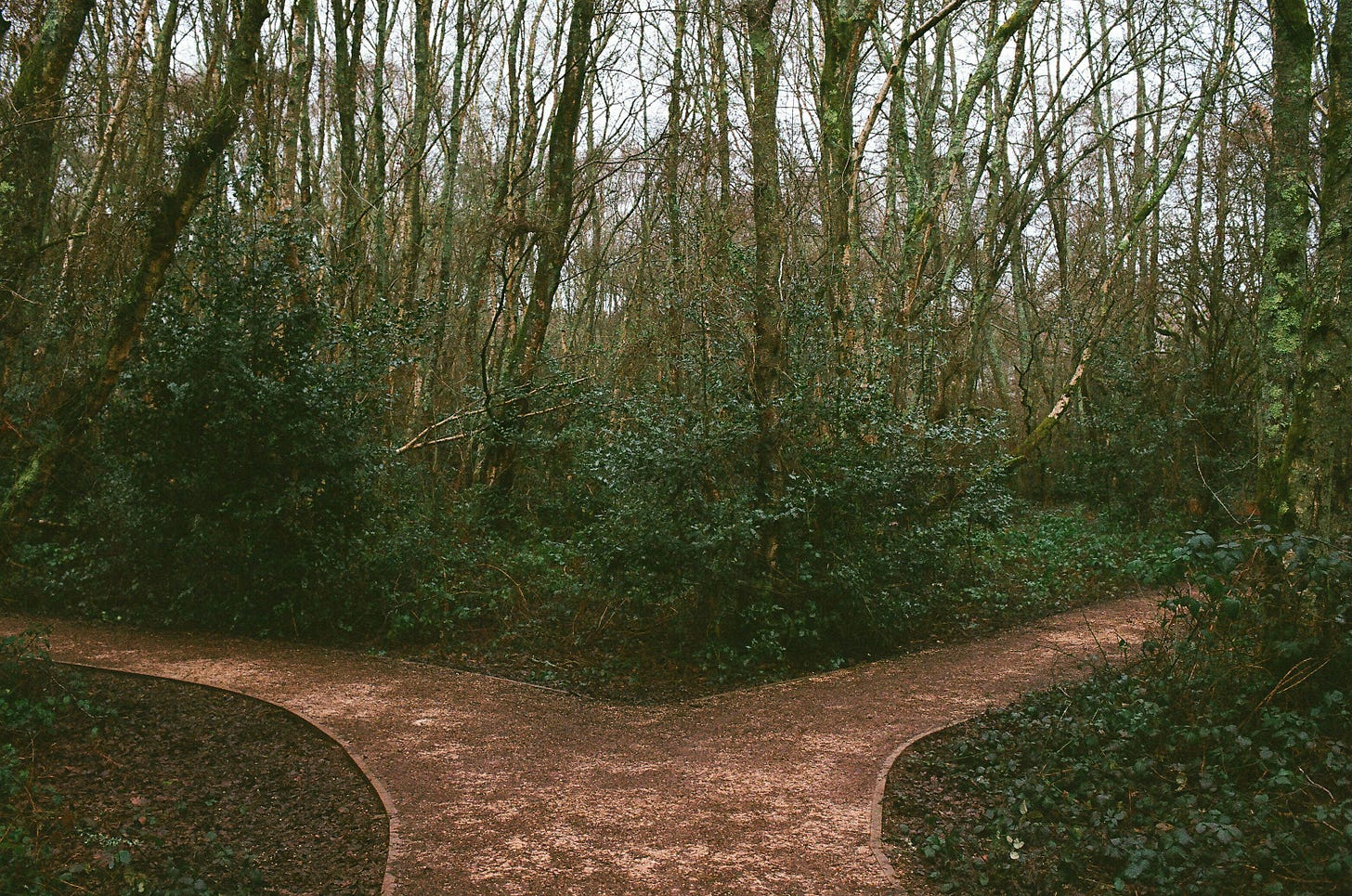
The photograph above has not changed. You have. What is it saying now?
Walter Calvo is Founder and Clinical Director of Camino Institute™, a transformation practice grounded in 2,500 years of philosophical wisdom and sustained clinical experience. He is a Licensed Clinical Social Worker and retired Air Force officer, former Director of Psychological Health and Director of Organizational Consulting, and holds a Doctor of Business Administration. He taught management, leadership, and organizational development at the graduate level.
Thanks for reading Beyond Coaching™ ! Subscribe for free to receive new posts and support my work.